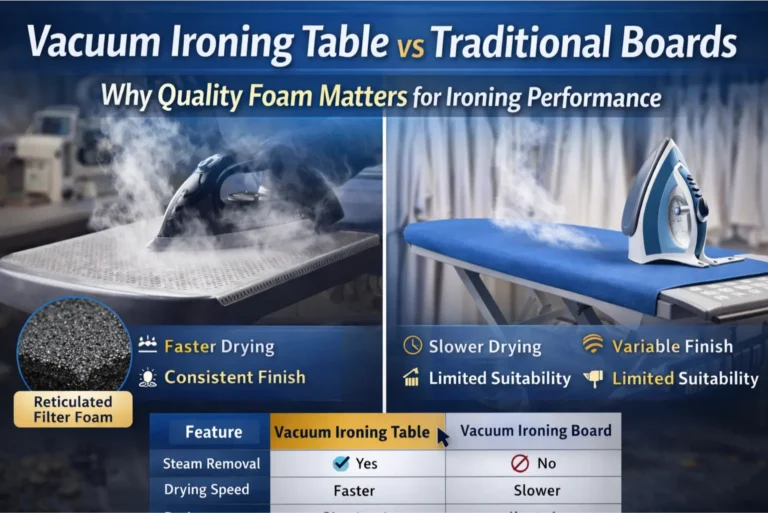
In commercial ironing, efficiency is shaped by design — and by what lies beneath the surface. Here’s how vacuum systems outperform traditional boards, and why foam quality plays a critical role.
In small tailoring shops, ironing is simple. A basic board and a steam iron are enough.
But in garment factories, export units, and commercial laundries, ironing is not just a task. It is part of production. Speed, finish, and consistency matter.
This is where the difference between Traditional Boards and a steam iron vacuum table becomes clear.
Let’s understand how a vacuum ironing board works, why it performs better, and why the quality of vacuum iron table foam plays a critical role.
What Makes a Steam Iron Vacuum Table Different?
A steam iron vacuum table looks similar to a regular ironing board at first glance. But the mechanism inside is very different.
It includes:
- A perforated metal top
- A suction motor
- Special vacuum iron table foam
- Sometimes, an attached boiler system
In an vacuum iron table foam the suction motor pulls air downward through the table surface. When steam is applied from the iron, the vacuum pulls moisture through the fabric.
This does three important things:
- Removes excess steam
- Dries fabric faster
- Prevents moisture from staying trapped
Some setups, like a vacuum ironing table with boiler, generate steam directly from the unit, making the process faster and more controlled.
Are Traditional Boards Enough for Industrial Ironing?
For home use, yes.
For commercial use, not always.
Traditional Boards do not have suction. When steam is applied:
- Moisture stays in the fabric
- Drying takes longer
- The finish may look uneven
- Fabric may shine or wrinkle again
In high-volume operations, this slows down productivity.
An industrial vacuum ironing table solves these problems by actively removing steam instead of letting it sit inside the garment.
That difference improves both speed and quality.
Where Does an Industrial Vacuum Ironing Table Deliver Maximum Value?
Not every setup needs advanced equipment. But in some places, a vacuum ironing board makes a big difference.
High-Volume Garment Manufacturing
In factories, hundreds of garments must be finished daily.
A steam iron vacuum table:
- Shortens the time it takes to press
- Makes creases sharper
- Keeps the quality of the finish the same
This means that things get done faster and there are fewer mistakes.
Commercial Laundry and Hospitality
Hotels and laundries take care of heavy fabrics like:
- Bed sheets
- Curtains
- Uniforms
An industrial vacuum ironing table helps get rid of steam quickly, which reduces the dampness and speeds up the drying process.
Tailoring and Export Units
When presentation matters, finishing quality becomes critical.
A vacuum ironing table with boiler offers better steam control. The vacuum ensures crisp folds and smooth surfaces, especially on formal wear and delicate fabrics.
What Role Does Vacuum Iron Table Foam Play?
Many people focus on the machine. But the foam inside the table is just as important.
The vacuum iron table foam sits between the perforated metal surface and the fabric. It supports airflow and pressure distribution.
Good foam ensures:
- Even suction across the surface
- Smooth fabric support
- Heat resistance
- Long-lasting performance
Poor-quality iron table foam can cause:
- Blocked airflow
- Uneven suction
- Reduced vacuum efficiency
- Frequent replacement
This is where engineered reticulated filter foam becomes important.
Why Reticulated Filter Foam Improves Performance
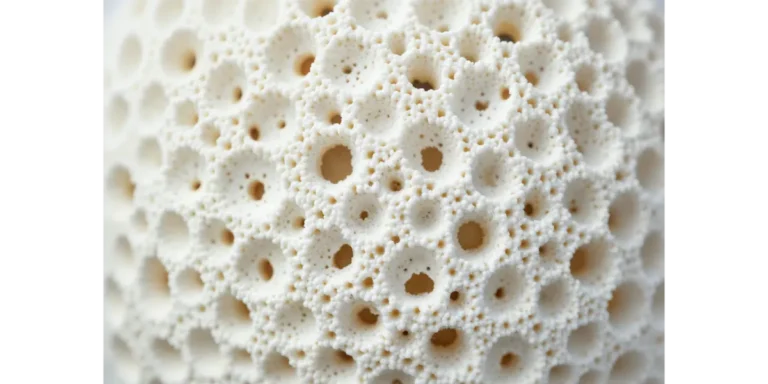
The reticulated foam structure is open-cell. This means that air can easily get through.
In a steam iron vacuum table, this structure:
- Makes the suction even
- Prevents airflow blockage
- Can be heated many times
- Holds its shape under pressure
High-quality reticulated filter foam helps vacuums work better than dense foam.
For any vacuum ironing board, foam is not just cushioning. It is part of the airflow system.
How Do You Choose the Right Vacuum Iron Table Foam?
If you are selecting foam for an industrial vacuum ironing table, look for:
- Open-cell structure
- Consistent porosity
- Heat tolerance
- Durability under pressure
- Resistance to compression
- Long service life
Reliable iron table foam improves the life of the equipment.
This is why working with an experienced reticulated filter foam matters. The foam must be engineered specifically for airflow and heat conditions.
Vacuum Ironing Table vs Traditional Boards – Quick Comparison
| Feature | Traditional Boards | Vacuum Ironing Board |
| Steam Removal | No | Yes |
| Drying Speed | Slower | Faster |
| Finish Quality | Variable | Consistent |
| Moisture Control | Low | High |
| Productivity | Moderate | High |
| Industrial Suitability | Limited | Ideal |
The difference becomes more visible in high-volume settings.
Efficiency Depends on What’s Inside
A steam iron vacuum table improves ironing speed, finishing quality, and moisture control. Compared to Traditional Boards, it offers clear operational advantages in commercial and industrial settings.
But performance does not depend only on the motor or boiler. The vacuum iron table foam inside plays a key role in airflow and durability.
At Kare Foam, we specialise in manufacturing engineered foam solutions designed for industrial performance. With over 15 years of experience as a trusted polyurethane foam manufacturer, we produce high-quality reticulated filter foam tailored for vacuum ironing applications.
Our vacuum iron table foam is designed to support uniform suction, withstand heat exposure, and maintain long-term structural stability. We understand that in commercial ironing systems, airflow efficiency directly affects productivity.
If you are upgrading your industrial vacuum ironing table or replacing existing iron table foam, we offer reliable, precision-crafted foam solutions built for demanding environments.
Explore our Vacuum Ironing Table Foam range and improve your ironing efficiency with confidence.