Here’s a clear look at the pros and cons of polyurethane foam to help you decide when it works best and when to consider alternatives.
One of the most common materials across various industries is polyurethane foam. It is everywhere, in furniture and mattresses, among many other things, like insulation, filtration, and industrial components. Polyurethane foam is a major contributor to the evolution of modern manufacturing. It owes its triumph to its versatility, wide performance range, and affordability.
However, like any material, it has both strengths and limitations. Understanding the pros and cons of polyurethane helps businesses, designers, and manufacturers choose the right foam for the right application.
Understanding Polyurethane Foam
What Is Polyurethane Foam?
Polyurethane foam is a polymer material created by reacting polyols with isocyanates. This reaction forms a cellular structure that can be engineered to be soft or rigid, open-cell or closed-cell, depending on how the foam is formulated and processed.
Because of this flexibility in design, poly foam can be customized for comfort, insulation, filtration, impact absorption, or structural support.
Common Types of Polyurethane Foam
- Flexible Polyurethane Foam
Is a material found in the likes of cushions, mattresses, seating, packaging, and also acoustic applications.
- Rigid Polyurethane Foam
Its a type of material that is utilized for thermal insulation purposes in buildings, cold rooms, appliances, and panels.
- Polyurethane Filter Foam
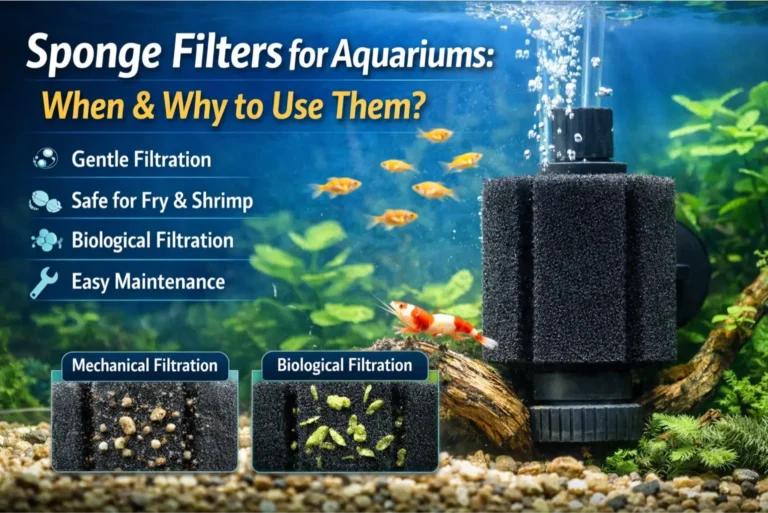
Is an open, cell foam that is designed to allow airflow and capture particles in air and water filtration. For more on the various types and uses of polyurethane foam, visit our guide on Polyurethane Foam: Uses & Types
- Reticulated Polyether Foam
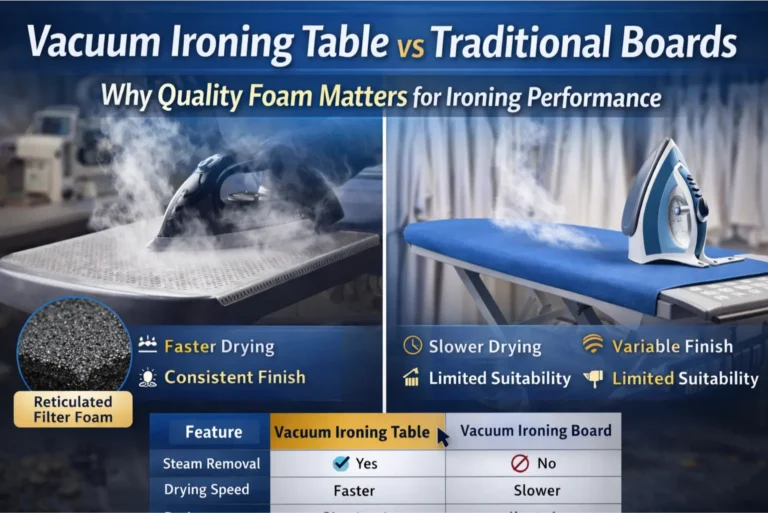
Is an extensively open, highly interconnected foam structure that is perfect for the use of filters, paint rollers, and any applications that require fast drainage and uniform flow.
Pros of Polyurethane Foam
1. Versatility Across Applications
One of the biggest advantages of polyurethane foam is how adaptable it is. A single material family can serve:
- Comfort products
- Insulation systems
- Automotive interiors
- Industrial filters
- Packaging and protective solutions
This versatility makes polyurethane a preferred choice for many polyurethane foam manufacturers and OEMs.
2. Customizable Properties
Foam can be engineered for specific needs, including:
- Density and hardness
- Cell size and openness
- Compression and rebound behavior
- Airflow and filtration efficiency
This allows a polyurethane foam supplier to tailor material performance precisely to the application.
3. Excellent Insulation Performance
Rigid polyurethane foam has low thermal conductivity, which is the main reason why it is highly effective in the following areas:
- Building insulation
- Refrigeration and cold storage
- Appliance insulation
Its capacity to lessen heat transfer is what makes energy efficiency possible, and this results in long-term cost savings.
4. Lightweight but Strong
Polyurethane foam, though it is very light, is still able to provide excellent strength and structural support. This feature has been instrumental in the reduction of product weight, with no performance loss; thus, the use of the foam has been greatly increased, especially in the automotive and industrial sectors.
5. Comfort and Impact Absorption
Flexible poly foam helps to absorb impact, and it also facilitates the even distribution of pressure. For this reason, it is extensively used in:
- Mattresses and seating
- Protective packaging
- Sports and safety equipment
6. Filtration and Airflow Control
Polyurethane filter foam, in particular a reticulated polyether foam, provides a steady airflow with a good particle capture efficiency. It is a common choice in HVAC systems, compressors, water filters, and industrial equipment.
7. Cost, Effective Over the Product Lifecycle
Polyurethane foam is a good compromise between performance and cost when it is properly specified. Its longevity will decrease the times of replacement, and its insulation capabilities can lead to energy savings in the long run.
Cons of Polyurethane Foam
1. Chemical Sensitivity and VOCs
Some polyurethane foams, during the manufacturing stage and the first use, can emit volatile organic compounds (VOCs). It is necessary to eliminate the risks related to exposure through curing, ventilation, and observance of safety standards.
2. Flammability Concerns
Polyurethane foam is a material that is inherently flammable. Although there are flame-retardant formulations available, it is essential to comply with fire safety regulations rigorously in such places.
3. Environmental Challenges
Although improvements have been made, polyurethane foam:
- Is not biodegradable
- Can be difficult to recycle
- Often ends up in landfills
The industry is moving toward better recycling methods and bio-based raw materials, but sustainability remains a challenge.
4. Quality Variability
Not all poly foam performs the same. Lower-grade foam may degrade faster, lose shape, or perform poorly under stress. This is why working with a reliable polyurethane foam supplier is critical.
5. Degradation Over Time
Exposure to UV light, heat, moisture, or chemicals can cause polyurethane foam to discolor, harden, or lose elasticity over time if it is not properly specified for the environment.
Polyurethane Foam Compared to Other Materials
1. Polyurethane Foam vs Memory Foam
Memory foam is a modified form of polyurethane with higher density and slower recovery. It offers excellent pressure relief but may trap heat and cost more than standard polyurethane foam.
2. Polyurethane Foam vs Latex Foam
Latex foam is more elastic and naturally hypoallergenic, but it is heavier and significantly more expensive. Polyurethane foam offers a wider range of performance options at a lower cost.
3. Polyurethane Foam vs Natural Materials
Materials like cotton or wool are biodegradable and breathable but lack the durability, insulation performance, and consistency that polyurethane foam provides in industrial and technical applications.
Innovations and the Future of Polyurethane Foam
The industry continues to evolve with:
- Bio-based polyols to reduce fossil fuel dependence
- Improved recycling technologies
- Better control over cell structure and performance
- Advanced reticulated foams for filtration and technical uses
These innovations aim to preserve the benefits of polyurethane while addressing environmental and safety concerns.
Making the Right Choice
The pros and cons of polyurethane show that it is neither a perfect nor a problematic material by default. Its success depends on:
- Proper formulation
- Correct application
- Reliable manufacturing and quality control
Choosing the right foam grade and supplier makes all the difference.
KareFoam’s Approach to Polyurethane Foam
At KareFoam, we focus on application-driven polyurethane solutions rather than one-size-fits-all products. As a specialized polyurethane foam manufacturer and supplier, we work closely with customers to match foam properties to real-world requirements.
Our expertise includes:
- Flexible and rigid poly foam solutions
- Reticulated polyether foam for filtration and paint rollers
- Polyurethane filter foam for airflow-critical applications
- Custom densities, pore sizes, and cut formats
By understanding both the benefits and limitations of polyurethane foam, we help customers make informed, long-term material choices.
If you are evaluating poly foam for comfort, insulation, or filtration, KareFoam can guide you toward a solution that performs reliably, scales efficiently, and fits your application needs.